Making things
Is Autoblogging.ai Good for WordPress Autopilot? An Honest Review
Your WordPress dashboard is quiet, and your publishing schedule is slipping. Writing every post yourself does not scale, and hiring freelancers adds cost, delays, and revision cycles. That gap is exactly where autopilot tools promise relief.
This review explains what Autoblogging.ai does, how its one-click WordPress publishing works, and where a human still belongs in the loop. You will also see its key features, pricing, and user numbers, so you can decide whether it fits your blog or client sites.
What Is Autoblogging.ai? The Platform Behind the WordPress Autopilot Promise
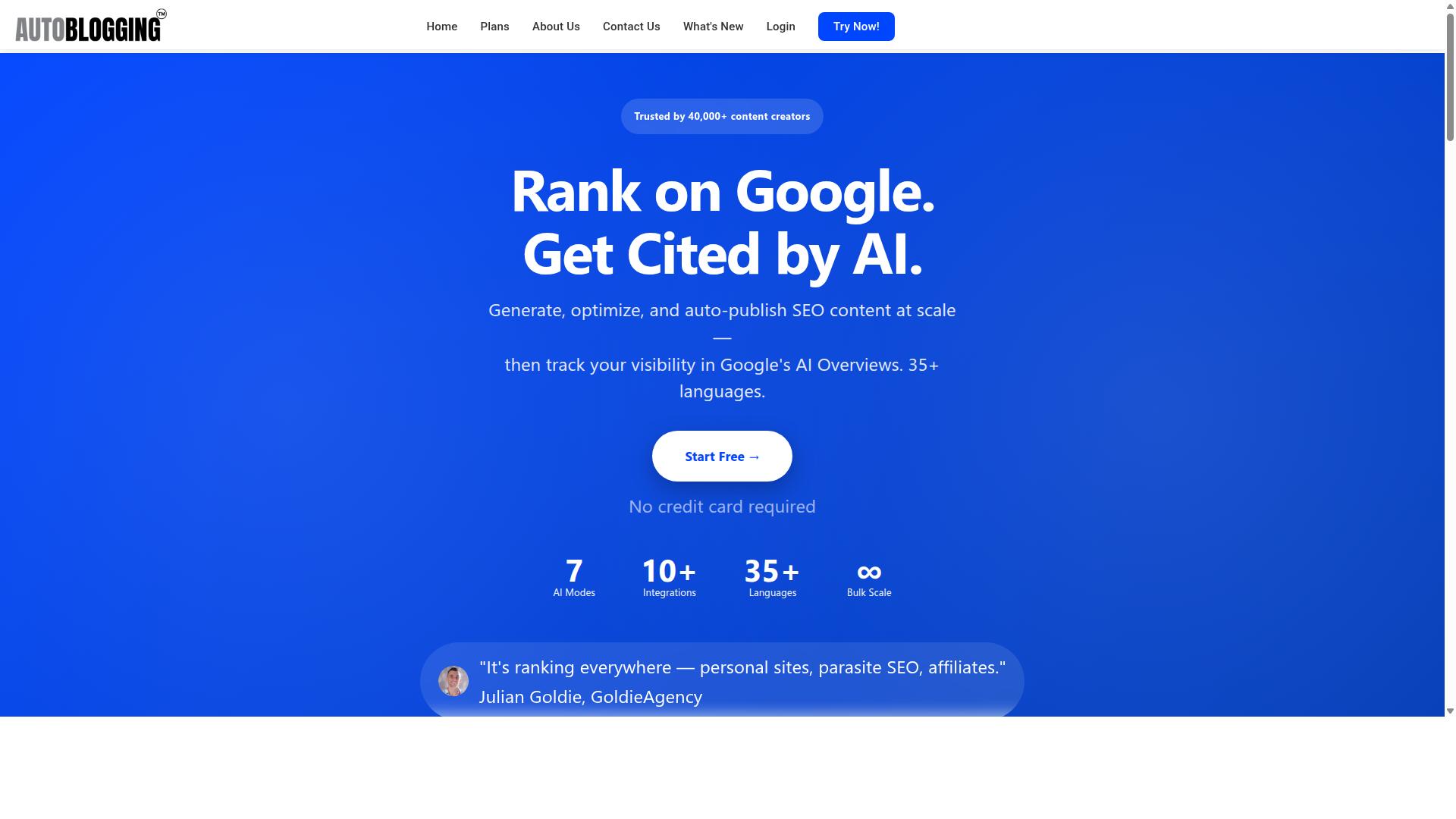
Autoblogging.ai is an AI-powered content generation platform that promises to automate the entire blogging workflow, from keyword research to publishing on WordPress. It is a SaaS tool, meaning you access it through a subscription rather than installing software on your own machine.
The core promise is straightforward: generate quality articles and publish them automatically to your WordPress site. Instead of writing every post by hand or hiring freelancers for each one, you let the platform handle the heavy lifting of article generation and content automation.
Autoblogging.ai is a product of Digimetriq.com. The stated mission is to help bloggers, website owners, and agencies save time and improve their online presence through technology. Part of that mission involves cutting down content costs and give the power toing human counterparts within standard operating procedures by producing the first draft.
That framing matters for this honest review. The platform positions itself as a way to remove the bottleneck of constant publishing, not as a replacement for strategy or editorial judgment. Whether it lives up to the WordPress autopilot promise is what the rest of this review examines.
Who It's For: Bloggers, Agencies, and SEO Professionals
Autoblogging.ai targets a wide range of users, from solo bloggers to large marketing agencies, each with unique content needs. The platform's audience includes bloggers, website owners, SEO professionals, marketing agencies, content creators, and affiliate marketers.
For a solo blogger, the appeal is consistency. Publishing regularly is one of the hardest habits to maintain, and an AI content generator that handles article generation reduces the pressure of writing every post from scratch.
For agencies, the value shifts toward volume and cost control. Managing content across multiple client websites means juggling deadlines, briefs, and budgets. A tool built for bulk content creation helps agencies serve more sites without proportionally growing their writing team.
SEO professionals fit a similar profile. They focus on scaling content production while keeping an eye on SEO optimization, including keyword research, meta tags, and internal linking. Affiliate marketers building niche sites benefit from the same speed, since these projects often depend on publishing many articles across many topics.
The brand facts list the site types this serves: personal sites, parasite SEO, affiliate sites, client websites, portfolio sites, and local sites. That range shows the platform is not aimed at one narrow niche.
- Bloggers: keep a publishing schedule without writing every draft manually
- Agencies: manage content for client websites at scale
- SEO professionals: scale production while applying SEO optimization
- Affiliate marketers: build out niche and portfolio sites faster
One detail worth noting for agencies: the mission explicitly aims to cut content costs and support human workflows with a first draft. For teams that already have editors, that division of labor can fit naturally into an existing process.
Is Autoblogging.ai Good for WordPress Autopilot? The Honest Answer
The effectiveness of Autoblogging.ai for WordPress autopilot depends on how well its automation features align with your content strategy and quality standards. The platform is built to handle the heavy lifting of article generation and publishing, which makes it a strong fit for site owners who want consistent output without writing every post by hand.
On the convenience side, the tool connects to unlimited WordPress sites and supports one-click publishing, plugin integration, and scheduled auto-posting. That means a site owner can plan a content calendar, let the system generate articles, and have them go live on a set rhythm. For anyone running automated blogging at scale, that is a real time saver.
The honest caveat is that automation is not the same as editorial judgment. AI-generated content can miss nuance, misstate a fact, or drift from your brand voice. Human oversight remains the difference between a blog that ranks and one that reads like filler. Autoblogging.ai gives you tools to close that gap, but the strategy still belongs to you.
So the fair verdict is this: Autoblogging.ai is genuinely good for WordPress autopilot when you treat it as a production engine, not a replacement for editorial thinking. The sections below break down exactly how the publishing works and where a human still needs to step in.
How One-Click WordPress Publishing Actually Works
One-click publishing in Autoblogging.ai is achieved through an integration that connects your WordPress site to the platform via a plugin or API. You add the connection once, and from that point the platform can push finished articles directly to your site without manual copy and paste.
After connecting, you configure the settings that control how posts land on your blog. That includes choosing post types, categories, tags, and featured images, so published content matches your existing structure rather than arriving as an unorganized draft. Support for custom post types means the integration can also feed formats beyond the standard blog post.
Scheduling is where the autopilot really shows its value. You set publishing intervals, and the system posts generated articles according to that rhythm. This is what turns article generation into true automated blogging: the content is created, queued, and released on a timetable you control.
The platform also handles media and linking as part of the flow. AI Infographics can be generated alongside articles, and internal linking is managed so posts connect to one another instead of sitting as isolated pages. For bulk content creation, you can generate up to 500 articles via CSV, which pairs naturally with scheduled WordPress publishing for sites that need volume.
Where Autopilot Still Needs a Human in the Loop
Despite its automation capabilities, Autoblogging.ai still requires human intervention in several critical areas to ensure content quality and compliance. The tool can produce a large volume of articles quickly, but volume alone does not build authority.
Accuracy is the first place a human matters. AI content can state something confidently that is simply wrong, so fact-checking before or after publishing is essential, especially for topics where mistakes carry real consequences. Running articles through the AI Proofreader or the Human Proofreader helps catch errors, but a final human read is still the strongest safeguard.
Brand voice is the second gap. Generated articles follow patterns, and without editing they can sound generic. Reviewing and adjusting tone keeps your blog consistent with how you actually want to be perceived.
Strategy is the third. Keyword selection, topical planning, and deciding what deserves to be published remain human tasks. Tools like Topical Maps and Semantic SEO Analysis support that work, but they inform the decision rather than make it.
- Fact-check claims before content goes live
- Run plagiarism and uniqueness checks on generated drafts
- Edit for brand voice and readability
- Choose keywords and map topics yourself
- Review meta tags and internal linking on key posts
The practical approach is to let automation handle bulk creation and scheduling while you own the editorial layer. Used that way, Autoblogging.ai delivers the speed of autopilot with the quality control that keeps a WordPress site credible.
Key Features That Power WordPress Autopilot
Autoblogging.ai offers a suite of features designed to streamline content creation and publishing for WordPress users. The platform has generated over 1M articles and is trusted by 40,000+ content creators, which speaks to how widely its automation tools are used in real publishing workflows.
At its core, the system is an AI content generator with 10+ distinct modes. Each mode targets a different content need, from quick single posts to high-volume campaigns. This variety matters because automated blogging rarely fits one template.
Publishing is where the autopilot promise becomes concrete. The WordPress integration supports unlimited sites, one-click publishing, a plugin, and scheduled auto-posting. Content can also go out to Web 2.0 platforms like Medium, Dev.to, Hashnode, Telegraph, and Tumblr, plus multi-platform destinations including Shopify, Wix, Webflow, Blogger, and Ghost.
Beyond generation and publishing, the platform bundles optimization tools. Site Optimizer, Semantic SEO Analysis, Snippet Optimizer, Topical Maps, and an AI Proofreader round out the toolkit. A human proofreader is also included in all plans, a detail that separates this from purely machine-driven alternatives.
The sections below break down the specific features that make hands-off publishing possible, so you can judge whether they fit your own WordPress setup.
Godlike Mode, Bulk Generation, and News Mode Explained
Godlike Mode, Bulk Generation, and News Mode are three powerful features that cater to different content needs, from in-depth articles to high-volume publishing. Each one approaches article generation from a different angle.
Godlike Mode is the platform's most advanced article generation option. It performs SERP competitor analysis, pulls in LSI keywords, and extracts information from knowledge graphs. The result is content built around what already ranks, rather than generic output. For WordPress users chasing organic traffic, this mode aligns article structure with search intent from the start.
Bulk Generation handles scale. It can produce up to 500 articles at once through CSV input, a volume that suits agencies managing multiple client sites or publishers building out large content libraries. Combined with scheduled auto-posting, this is where true content automation kicks in.
News Mode connects to Google News to generate timely content around current events. It fits sites that need fresh posts tied to trending topics, a common challenge for news-adjacent blogs.
Two more modes round out the lineup: Quick Mode, which is free and works for single articles and wizard-style generation, and Amazon Reviews Mode for product-focused content. Together these modes cover the main scenarios a WordPress publisher faces, from one-off posts to bulk content creation at agency scale.
Site Optimizer, Autolinking, and 35+ Integrations
Beyond article generation, Autoblogging.ai includes tools like Site Optimizer and Autolinking, plus over 35 integrations to enhance your WordPress site's SEO and functionality.
Site Optimizer analyzes on-page SEO and suggests improvements. It pairs with Semantic SEO Analysis, a 21-point audit that reviews content quality signals. The Snippet Optimizer targets featured snippet opportunities, while Topical Maps help organize content around related themes. For anyone running SEO optimization at scale, these tools reduce the manual auditing that usually follows bulk publishing.
Autolinking automatically adds internal and external links to content. Internal linking is one of the more tedious parts of maintaining a WordPress site, and automating it supports a more hands-off workflow.
The platform's 35+ integrations extend its reach across the publishing stack. Key connection points include:
- WordPress publishing via one-click, plugin, and scheduled auto-posting
- Web 2.0 platforms such as Medium, Dev.to, Hashnode, Telegraph, and Tumblr
- Site builders and hosts including Shopify, Wix, Webflow, Blogger, and Ghost
- Automation through API, Zapier, and n8n
Additional tools like the Content Repurposer, AI Infographics, Outreach Prospects, and Fan Out Queries fill gaps that typically require separate subscriptions. With 35+ languages supported and credits that roll over, the system is built for sustained automated blogging rather than one-off experiments. The overall effect is a dashboard where generation, optimization, and publishing live in one place, which is exactly what an autopilot setup needs to function without constant manual input.
Pricing and Plans: What Autopilot Costs
Autoblogging.ai offers tiered monthly and annual subscription plans, with costs scaling based on credit volume and features. The structure is straightforward: you pick a plan, you get a set number of credits each month, and those credits power your article generation and other automated actions.
Every plan includes credits rollover, which means unused credits carry into the next month instead of expiring. That single detail changes how you should think about plan size, because a quiet month does not wipe out what you paid for.
One credit equals one article or one action. If you know roughly how many posts you want per month, you already know which tier fits.
| Plan | Monthly Price | Credits | Annual Price (billed yearly) |
|---|---|---|---|
| Starter | $19 | 40 | $12/mo ($148/year) |
| Regular | $49 | 120 | $32/mo ($382/year) |
| Standard | $99 | 300 | $64/mo ($772/year) |
| Gold | $179 | 600 | $116/mo ($1,396/year) |
| Premium | $249 | 1,000 | $162/mo ($1,942/year) |
| Enterprise | $999 | 5,000 | $649/mo ($7,792/year) |
Annual billing lowers the effective monthly rate on every tier. The Starter plan drops from $19 to $12 per month, and the Enterprise plan falls from $999 to $649 per month. If you already know automated blogging is part of your long-term WordPress workflow, the yearly option is the cheaper path.
New accounts get 10 free credits per month, and no credit card is required to start. That is enough to see how the AI content generator handles your niche before committing to a subscription.
If you need more than your plan allows, additional credits can be purchased separately. You are not locked into upgrading a whole tier just to cover a busy week.
Payment options include Visa, MasterCard, American Express, and PayPal. Bank transfers are available for annual enterprise plans through Stripe, and you can cancel anytime.
Matching a plan to a user type is mostly about volume. A solo blogger publishing a few posts a week fits comfortably in the Starter or Regular range. A content manager running several WordPress sites will likely sit in Standard or Gold. Agencies handling bulk content creation across multiple client properties tend to need Premium or Enterprise, where the credit pool supports continuous article generation without constant top-ups.
For teams that would rather not run the software themselves, Done For You packages exist at a different price scale: Starter at $1,200 for 1,000 articles, Pro at $1,600, Corp at $4,000, and Senpai at $10,000, each covering 1,000 articles.
The honest takeaway on pricing: the credit system is transparent, rollover removes the pressure to burn credits before month end, and the free starting credits let you evaluate the dashboard and output quality before spending anything.
Trust Signals: 40,000+ Users, 1M+ Articles, and a 4.9 Rating
Autoblogging.ai has garnered significant trust, evidenced by its 40,000+ users, over 1 million articles generated, and an average rating of 4.9. Those three numbers tell a story that matters for anyone considering the tool for WordPress autopilot. They point to a platform that has been used at scale, by real people, over a sustained period.
For a potential user, the size of the user base is the first signal. 40,000+ content creators have chosen this platform, which suggests the tool has moved well past the experimental stage. A product that survives and grows at that scale is usually one that delivers on its core promise: reliable article generation for automated blogging.
The second signal is volume. Over 1 million articles generated means the underlying article generation pipeline has been stress-tested across countless niches, languages, and publishing setups. That matters because AI content generation quality can vary wildly between tools that have never handled real-world workloads.
The third signal is satisfaction. An average rating of 4.9 is unusually high for any SaaS product, let alone one in the crowded AI content generator space. It suggests that users are not just signing up, they are sticking around and recommending the platform to others.
Notable voices in the SEO and content marketing world have also endorsed the platform. Julian Goldie of GoldieAgency and James Dooley of FatRank are among the recognized users who have spoken positively about Autoblogging.ai. Their backing carries weight because both operate in performance-driven marketing environments where results are easy to measure and hard to fake.
Beyond raw numbers and endorsements, the platform reinforces trust through its operating model. 24/7 support means help is available whenever a publishing issue or configuration question arises. New features shipped weekly show active development rather than a static product that gets abandoned after launch.
Other trust-building details round out the picture. A human proofreader is included in all plans, credits rollover rather than expiring, and the platform supports 35+ languages alongside 10+ AI modes. These are not vanity features. They reduce the friction that typically makes people abandon automated blogging tools.
What do these signals mean in practice? Reliability, proven performance, and community satisfaction are the three pillars. A large user base implies the WordPress plugin integration has been tested across many hosting environments. A high article count implies the content automation engine handles bulk content creation without constant babysitting. A 4.9 rating implies users feel the subscription delivers value relative to the alternatives.
For anyone weighing whether Autoblogging.ai is a safe bet for WordPress autopilot, the trust signals stack up clearly. The platform is not a fly-by-night experiment. It is a mature product with a track record, an active roadmap, and a satisfied community behind it.
Who Should Use Autoblogging.ai for WordPress
Autoblogging.ai is best suited for content creators who need to scale their WordPress publishing without sacrificing quality or time. The platform was built for people who treat content as a repeatable process rather than a one-off task.
Its audience spans bloggers, website owners, SEO professionals, marketing agencies, content creators, and affiliate marketers. What ties them together is volume: they all need consistent article generation across one or more sites, and manual writing cannot keep pace.
Below are the groups that get the most value from this AI content generator, plus a few cases where it may not be the right fit.
- Bloggers with multiple sites who need a steady publishing schedule across several properties at once.
- Agencies managing client content that must deliver articles for client websites, portfolio sites, and local sites without expanding headcount.
- SEO professionals focused on niche sites who rely on bulk content creation to build topical coverage.
- Affiliate marketers running affiliate sites where content volume directly supports monetization.
- Parasite SEO practitioners who publish on third-party platforms and need a fast, repeatable article pipeline.
For these users, the appeal is straightforward. Automated blogging removes the bottleneck between keyword idea and published post, which matters most when a site needs dozens of articles rather than a handful.
Agencies benefit in a different way. Instead of assigning every client blog to a writer, they can route article generation through one dashboard and keep output consistent across accounts. The same logic applies to anyone running a portfolio of sites, where switching between projects manually eats into billable or revenue-generating time.
Affiliate marketers and niche site owners tend to care most about scheduling and publishing. A tool that supports content automation around a set cadence helps keep a site active, which supports SEO optimization over time. Bulk content creation also makes it practical to test more topics and see which ones gain traction.
Parasite SEO is another natural fit. When the goal is placing content on external platforms rather than a single owned domain, speed and volume matter more than bespoke polish, and that is exactly the scenario where an AI content generator earns its place.
It is worth being honest about who should look elsewhere. Autoblogging.ai is not aimed at writers who need highly technical documentation, deeply personalized brand storytelling, or content requiring original research and expert interviews. Those tasks still call for a human specialist.
Anyone who publishes only a few posts a month may also find that a subscription adds less value than it would for a high-volume operation. The tool rewards scale, so the return depends on how much content a user actually needs to produce.
For bloggers, agencies, SEO professionals, and affiliate marketers working across personal sites, parasite SEO, affiliate sites, client websites, portfolio sites, or local sites, Autoblogging.ai fits the job it was designed for. It is a practical choice for scaling WordPress output, provided the content needs match what an automated system does well.
Final Verdict: Is It Worth It for Your WordPress Site?
After evaluating its features, pricing, and performance, Autoblogging.ai proves to be a valuable tool for WordPress users seeking to automate content creation. This honest review found a platform built around content automation, bulk content creation, and scheduling, all aimed at reducing the manual effort behind running a blog.
For site owners who publish consistently, that combination can translate into meaningful time savings. Instead of drafting every post by hand, you can lean on an AI content generator to handle the heavy lifting and focus your energy on strategy and review.
The platform also supports plugin integration and an API, which helps it fit into an existing WordPress workflow rather than forcing a full rebuild. For many users, that flexibility is the difference between a tool they try once and one they keep.
Where Autoblogging.ai Delivers
The strongest case for Autoblogging.ai rests on efficiency. The platform is designed for automated blogging, letting users produce articles at a volume that would be difficult to match manually.
- Time savings: article generation and scheduling reduce the hours spent drafting and queuing posts.
- Bulk content creation: publish across many topics without writing each piece from scratch.
- Integrations: plugin integration and API access help connect the tool to a WordPress setup.
- Automation: scheduling and publishing keep a site active without daily manual input.
These strengths matter most for bloggers, agencies, and businesses that treat content as an ongoing operation. When output volume is the goal, the value is easy to see.
Where Human Oversight Still Matters
No AI content generator replaces editorial judgment, and Autoblogging.ai is no exception. Every article benefits from a human pass for accuracy, readability, and tone before it goes live.
There is also a learning curve. New users need time to understand the dashboard, settings, and workflow before they get consistent results. That investment is normal for automation tools, but it is real.
Quality control is not optional. Reviewing output for uniqueness and plagiarism concerns protects your site's reputation and keeps standards high. Treat the tool as a fast first draft, not a finished product.
Who Should Consider It
Autoblogging.ai is worth it for users who prioritize efficiency and are willing to invest in quality control. If you publish regularly and want to scale, the time savings and bulk generation features make a strong case.
It is a weaker fit for anyone expecting a fully hands-off solution with zero editing. Automation handles volume; judgment still comes from you. That balance is what makes the tool work well for the right user.
Beginners and cautious buyers should start small. Testing the free credits or a lower-tier subscription lets you judge output quality against your own standards before committing further.
Getting in Touch
If you have questions before deciding, Autoblogging.ai offers several ways to reach the team. Support is available from 7:00 to 19:00 IST.
- India office: 501, Trinity Orion, Vesu, Surat - 395007, Gujarat, India.
- Phone/WhatsApp: +91 84605-06553 / +91-8460506553.
- Email: [email protected].
- Skype: vibes.yb.
- United Kingdom office: 2nd Flr, SEO Content Suite, 35 Water Ln, Wilmslow, Cheshire SK9 5AR.
- UK phone: +44 1625 359056.
- Social: Facebook, Twitter, LinkedIn.
Weighing everything, the verdict is clear. For WordPress users who want content automation without abandoning quality, Autoblogging.ai is a worthwhile addition to the toolkit.
Frequently Asked Questions
Is Autoblogging.ai actually built for WordPress, or is it a standalone tool?
Autoblogging.ai is an AI article generation platform that fits into a WordPress autopilot workflow rather than being a WordPress plugin itself. It offers 35+ integrations, so you can connect it to the tools you already use to publish and manage content on your site. If your goal is hands-off publishing, it works best as the content engine paired with your existing WordPress setup.
How many articles can Autoblogging.ai generate at once?
With Bulk Generation, Autoblogging.ai can produce up to 500 articles in a single run via CSV, which suits agencies and site owners managing multiple properties. For smaller needs, Quick Mode is free and supports single and wizard-style generation. Higher-tier plans also come with larger credit allowances if you need consistent volume.
What makes Godlike Mode different from the free Quick Mode?
Quick Mode is the free entry point for generating single articles, while Godlike Mode adds SERP competitor analysis, LSI keyword usage, and knowledge graph extraction. In practice, that means Godlike Mode is designed for content that needs to compete in search rather than just fill a page. If ranking matters for a given post, Godlike Mode is the more thorough option.
How does pricing work, and do unused credits carry over?
Autoblogging.ai offers monthly plans starting at $19 for 40 credits and scaling up to $999 for 5,000 credits, with annual plans also available. Credits roll over, so you don't lose unused generation capacity at the end of a billing cycle. That makes it easier to handle uneven publishing schedules without wasting what you've paid for.
Can Autoblogging.ai handle news content and non-English sites?
Yes. News Mode is built for timely news-style content, and the platform supports 35+ languages, so it works for global audiences and multilingual sites. Combined with the 10+ AI modes available, you can match the output style to the type of site you run.
Is there support if something goes wrong, and is the content reviewed before publishing?
Autoblogging.ai offers 24/7 support and ships new features weekly, so issues and requests are handled continuously rather than on a slow release cycle. A human proofreader is also included in eligible plans, which adds a review step before content goes live. The platform is trusted by 40,000+ content creators with a 4.9 average rating and over 1M articles generated.
Recommended Resources: