Making things
Koala AI vs Autoblogging.ai: Which SEOWriting AI Alternative Wins
You are comparing Koala AI and Autoblogging.ai, and both promise the same output: publish-ready articles without a writer. The difference shows up in bulk generation limits, SERP analysis, and how each tool handles the human proofreading step before publishing.
This comparison breaks down content modes, optimization features, integrations, and pricing so you can see where each platform fits. By the end, you will know which tool matches your workflow and get a clear verdict, not a vague "it depends."
Quick Verdict: Koala AI vs Autoblogging.ai
If you're deciding between Koala AI and Autoblogging.ai, the quick verdict is that Autoblogging.ai excels for high-volume, SEO-driven content with its Godlike Mode and human proofreader, while Koala AI offers a simpler, more affordable entry point for basic content needs.
Autoblogging.ai brings SERP competitor analysis, semantic SEO tools, and a 21-point SEO audit to every plan, backed by 10+ AI modes, 35+ languages, and one-click WordPress publishing. It is trusted by 40,000+ content creators and has generated 1M+ articles, which makes it the stronger pick for agencies and SEO professionals who need scale.
Koala AI keeps things straightforward for beginners or anyone on a tight budget, though it trades away the depth of bulk content creation and keyword optimization that serious campaigns demand. For teams where content quality, readability, and search performance drive results, Autoblogging.ai is the more complete article generator.
At a glance: how Autoblogging.ai compares to Koala AI on the features that matter most.
| Feature | Autoblogging.ai | Koala AI |
|---|---|---|
| Pricing | $19-$999/mo | $25-$2,000/mo |
| Free plan / trial | 10 free credits/mo | Free start, no card |
| WordPress integration | ✓ | ✓ |
| Bulk article generation | ✓ | ✓ |
| API access | — | ✓ |
| SEO optimization tools | ✓ | ✓ |
| AI image generation | ✓ | ✓ |
| Languages supported | 35+ | — |
What Is Autoblogging.ai?
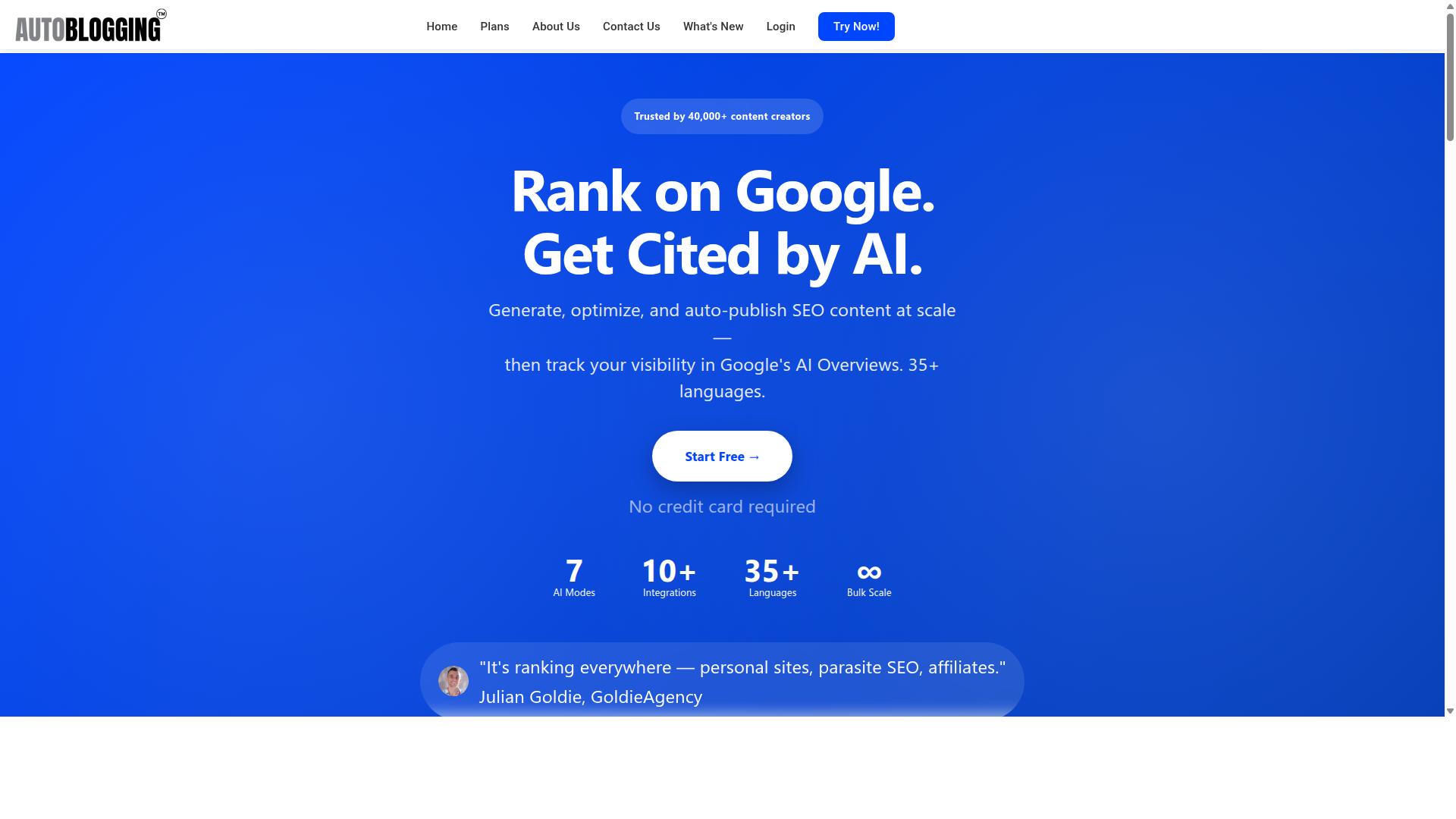
Autoblogging.ai is an AI-powered content generation platform designed to help bloggers, agencies, and SEO professionals produce high-quality articles at scale. It is a SaaS product built by Digimetriq.com and founded in 2022 by Vaibhav Sharda.
The mission behind the platform is straightforward: help bloggers, website owners, and agencies save time and improve their online presence through cutting-edge technology. Part of that mission is cutting down content costs and enableing human counterparts in standard operating procedures with a strong first draft.
For anyone comparing it to Koala AI or SEOWriting AI, the key distinction is breadth. Autoblogging.ai bundles generation, optimization, and publishing into a single workflow, rather than treating each step as a separate task.
Modes, Integrations, and the Human Proofreader Edge
Autoblogging.ai offers a range of AI writing modes, from the free Quick Mode to the advanced Godlike Mode that performs SERP competitor analysis and extracts LSI keywords. Each mode targets a different level of depth and scale, so users can match the tool to the job at hand.
The main options break down like this:
- Quick Mode: free to use, with both a single article option and a wizard for guided generation.
- Godlike Mode: runs SERP competitor analysis, pulls in LSI keywords, and performs knowledge graph extraction for deeper topical coverage.
- Bulk Generation: produces up to 500 articles in one pass via CSV, which suits agencies and portfolio builders.
- News Mode: connects to Google News for timely, current-angle content.
- Amazon Reviews Mode: built for product-focused and affiliate style writing.
That range matters for bulk content creation. Someone managing a network of sites can generate 500 articles in one go instead of queuing single requests, which changes the economics of content automation entirely.
Publishing is where the platform separates itself further. There are 35+ integrations in total, including WordPress integration with unlimited sites, one-click publishing, a plugin, and scheduled auto-posting. Web 2.0 platforms such as Medium, Dev.to, Hashnode, Telegraph, and Tumblr are supported, alongside multi-platform options like Shopify, Wix, Webflow, Blogger, and Ghost. An API plus Zapier and n8n connections cover custom stacks.
Content quality gets its own layer of protection. An AI Proofreader and a Human Proofreader both sit in the toolkit, and the platform supports 35+ languages for teams working across markets. Optimization tools round things out, including Site Optimizer, Semantic SEO Analysis with a 21-point audit, Snippet Optimizer, Topical Maps, Intense Optimizer, Fan Out Queries, AI Infographics, Outreach Prospects, and a Content Repurposer.
For keyword optimization and SERP analysis, Godlike Mode does the heavy lifting by studying what already ranks before writing begins. Combined with LSI keywords and knowledge graph extraction, that approach supports semantic similarity and entity extraction rather than surface-level keyword stuffing.
The practical benefit is time. Instead of moving between an AI article writer, a separate optimizer, and a publishing tool, users keep the whole path in one place. Done For You packages are also available for those who want the output handled end to end.
What Is Koala AI?
Koala AI is a web-based AI writing assistant that helps users generate blog posts, articles, and other content quickly, with a focus on simplicity and affordability. Based on publicly available information, it appears to be aimed at individuals and small teams who want a straightforward way to produce written material without a steep learning curve.
The platform generally leans on AI-powered content generation to turn a prompt or outline into a draft. It likely offers a user-friendly interface that keeps setup minimal, which makes it appealing to bloggers, freelancers, and small businesses testing AI writing tools for the first time.
Like most tools in this space, Koala AI probably covers common tasks such as drafting articles, generating ideas, and adjusting tone. Readers comparing it to a dedicated SEO content generator should note that general writing assistants and specialized article generators often differ in depth of keyword optimization and publishing workflows.
Features Compared
When comparing features, Autoblogging.ai and Koala AI cater to different needs: Autoblogging.ai emphasizes advanced SEO and bulk generation, while Koala AI focuses on ease of use and core writing capabilities.
That split shapes everything below. One platform is built for volume and search visibility, the other leans toward simple article drafting.
This section breaks the comparison into three areas: content generation modes, SEO and optimization tools, and the languages, integrations, and publishing workflow that decide how fast content actually goes live.
Readers weighing an AI article writer for serious output should pay closest attention to the second and third areas, since those usually separate a hobby tool from a working content system.
Content Generation Modes and Bulk Output
Autoblogging.ai provides multiple content generation modes, including a free Quick Mode and a Godlike Mode that leverages SERP analysis, while also supporting bulk generation of up to 500 articles at once.
Quick Mode handles single articles and includes a wizard option, which suits writers who want a fast draft without a long setup. Godlike Mode goes further, pulling in search data to shape the output. Across the platform, users get access to 10+ AI modes, covering different content types and use cases.
Bulk generation is where the gap widens. Autoblogging.ai accepts a CSV and produces up to 500 articles in one run, a workflow aimed squarely at agencies and high-volume publishers managing many sites or client accounts.
Koala AI, by contrast, is generally described as a tool for producing individual articles, and any bulk capability it offers appears more limited in scope. That distinction matters most for teams running blog post automation at scale, where generating one post at a time becomes a bottleneck.
- Quick Mode: free, single article, wizard option
- Godlike Mode: SERP competitor analysis built in
- Bulk Generation: up to 500 articles via CSV
- Additional modes: News Mode and Amazon Reviews Mode
For a solo blogger, a single-article tool may be enough. For anyone treating content as a pipeline, the bulk ceiling is the deciding factor.
SERP Analysis, Semantic SEO, and Optimization Tools
Autoblogging.ai's Godlike Mode includes SERP competitor analysis, LSI keyword extraction, and knowledge graph integration to optimize content for search engines.
Those three elements work toward keyword optimization from different angles. SERP analysis looks at what already ranks, LSI keywords help cover related terms a topic needs, and knowledge graph extraction supports entity-level relevance. Together they push output closer to what search engines treat as complete coverage of a subject.
The optimization layer extends beyond drafting. Autoblogging.ai offers a 21-point SEO audit through Semantic SEO Analysis, plus a Snippet Optimizer for featured snippet targeting, a Site Optimizer, Topical Maps, Intense Optimizer, and Fan Out Queries.
Koala AI may include some basic SEO settings, but its toolset appears centered on writing rather than on ranking mechanics. Specifics around its optimization depth are not clearly documented, so buyers should verify current capabilities directly.
This is the clearest edge for SEO professionals. A SEO content generator that folds competitor research and semantic analysis into the draft saves an entire manual research stage. Autoblogging.ai also bundles an AI Proofreader and a Human Proofreader, so content quality checks sit inside the same workflow rather than in a separate tool.
Languages, Integrations, and Publishing Workflow
Autoblogging.ai supports over 35 languages and integrates with 35+ platforms, including WordPress, enabling a seamless publishing workflow.
Language coverage at that scale opens up multilingual sites and regional campaigns without switching tools. On the integration side, Autoblogging.ai connects to WordPress with one-click publishing, a plugin, and scheduled auto-posting across unlimited sites. It also supports Web 2.0 destinations such as Medium, Dev.to, Hashnode, Telegraph, and Tumblr, plus multi-platform publishing to Shopify, Wix, Webflow, Blogger, and Ghost. API access, Zapier, and n8n round out the automation options.
Koala AI likely supports multiple languages and a handful of integrations, though the exact count and platform list are not firmly established. Buyers comparing on this axis should confirm what is available at the time of purchase.
The workflow difference is practical. With WordPress integration and scheduled posting, content moves from draft to live without manual uploading, which is what makes bulk content creation genuinely useful rather than just fast.
Autoblogging.ai also includes a Human Proofreader in all plans and ships new features weekly. For teams that publish often, that combination of reach and review keeps output both broad and presentable.
Pricing Compared
Pricing is a key differentiator: Autoblogging.ai offers tiered monthly and annual plans with credits that roll over, while Koala AI typically provides simpler subscription options.
Autoblogging.ai's published plans start at $19 per month for 40 credits and scale up to $999 per month for 5,000 credits. Annual billing lowers the effective monthly rate on every tier. Koala AI's pricing sits in a similar general range for AI writing tools, but the company presents it in a more limited structure.
That difference matters once you compare what each credit actually delivers. The sections below break down the plan tiers, the rollover policy, and how to judge value.
Autoblogging.ai Plans, Credits, and Rollover Value
Autoblogging.ai's pricing plans range from Starter at $19/month for 40 credits to Enterprise at $999/month for 5,000 credits, with annual billing options and unused credits that roll over.
Six monthly tiers cover most content automation needs, from solo bloggers to agencies running bulk content creation at scale.
| Plan | Monthly Price | Credits | Annual Price |
|---|---|---|---|
| Starter | $19 | 40 | $12/mo ($148/year) |
| Regular | $49 | 120 | $32/mo ($382/year) |
| Standard | $99 | 300 | $64/mo ($772/year) |
| Gold | $179 | 600 | $116/mo ($1,396/year) |
| Premium | $249 | 1,000 | $162/mo ($1,942/year) |
| Enterprise | $999 | 5,000 | $649/mo ($7,792/year) |
Annual billing cuts the effective monthly rate by roughly a third on every tier. New accounts also get 10 free credits per month with no credit card required, and additional credits can be purchased separately when a project spikes.
The standout feature is credit rollover. If you generate fewer articles in a slow month, the unused credits carry forward instead of expiring. For anyone doing blog post automation around seasonal demand, that flexibility prevents paying twice for the same capacity.
Koala AI has its own pricing tiers, but the structure and exact rates are best confirmed on their website. What is clear from the two models: Autoblogging.ai pairs granular plan levels with rollover, while Koala AI keeps things simpler. If you want a plan that flexes with your output instead of resetting every month, the tiered, rollover-based approach is the stronger fit.
Who Should Choose Autoblogging.ai
Autoblogging.ai is ideal for bloggers, SEO professionals, marketing agencies, and affiliate marketers who need to produce large volumes of SEO-optimized content efficiently. The platform is built for people whose livelihood depends on publishing consistently, not for those who write one post a month.
If your workflow involves managing multiple sites or clients, the appeal is obvious. Bulk content creation and content automation matter far more than a single clever draft when your calendar is packed.
Autoblogging.ai serves a wide range of site types, including:
- Personal sites and blogs
- Parasite SEO projects
- Affiliate sites
- Client websites managed by agencies
- Portfolio sites
- Local sites targeting specific regions
That spread tells you something useful. The tool fits projects where output needs to scale across different niches, audiences, and business models without rebuilding a process each time.
Several features speak directly to these users. Bulk generation supports publishing at volume. Godlike Mode targets higher content quality for competitive topics. A human proofreader adds a review layer that agencies and affiliate marketers often need before anything goes live on a client site.
For SEO professionals, these capabilities map onto real deliverables. An AI article writer that handles keyword optimization and readability concerns reduces the manual grind, letting you focus on strategy, SERP analysis, and link building instead.
The track record backs the positioning. Autoblogging.ai is trusted by 40,000+ creators and has generated 1M+ articles. That scale reflects a user base that publishes continuously, not occasionally.
Affiliate marketers, in particular, tend to run many small sites rather than one large property. Bulk generation and consistent output keep those portfolios active, which is often the difference between a project that gains traction and one that stalls.
Agencies face a different pressure: client expectations. A human proofreader in the workflow helps maintain content quality across accounts, while bulk features keep turnaround times realistic when several clients need fresh pages in the same week.
Local site owners and portfolio builders benefit too. They typically need steady streams of location or service pages, and automation handles that repetition without demanding a full content team.
If your priority is publishing a high volume of SEO-focused content across one or many sites, Autoblogging.ai is the stronger fit in this comparison. Tools like Koala AI may suit lighter or more occasional writing needs, but for blog post automation at scale, the feature set here aligns more directly with how professional publishers actually work.
Who Should Choose Koala AI
Koala AI is best suited for individuals, small business owners, or beginners who need a straightforward AI writing tool for occasional content creation without advanced SEO features. If your main goal is to draft a quick post without learning a complex dashboard, a simpler tool can feel less intimidating than a full content automation platform.
These users typically value simplicity and affordability over depth. They may publish a handful of articles per month, run a personal blog, or manage social media captions for a local business. In those cases, a lightweight AI article writer can cover the basics without overwhelming the person using it.
It also helps to think about how often you will actually use the tool. Someone writing one or two pieces a week has different needs than a marketer running bulk content creation across multiple sites. Occasional use rarely justifies a steep learning curve, so an easy interface often wins by default.
Common scenarios where a simpler tool fits well include:
- Personal blogs with infrequent publishing schedules
- Social media captions and short promotional blurbs
- Small-scale projects where one person handles everything
- Beginners testing whether AI writing tools fit their workflow
- Freelancers drafting first versions for clients to review
That said, simpler tools come with trade-offs worth knowing before you commit. Basic generators may offer limited SERP analysis, shallow keyword optimization, and fewer controls over structure or tone. Readers should check whether a tool supports readability checks, plagiarism screening, or any form of AI detection review before relying on it for published work.
Beginners should also consider where their content needs will be in six months. A tool that feels comfortable today may feel limiting once publishing picks up, and switching platforms later means relearning settings and rebuilding habits. Choosing based on current volume alone can lead to an early upgrade.
For anyone whose ambitions include consistent publishing, ranking-focused content, or scaling output, a purpose-built SEO content generator tends to serve better over time. Autoblogging.ai is designed for exactly that path, pairing automation with optimization so growing sites are not held back by a tool built for occasional drafts. Koala AI remains a reasonable starting point for casual creators, but it is not the stronger pick once content becomes a serious channel.
Final Verdict
After comparing features, pricing, and use cases, Autoblogging.ai emerges as the superior choice for professionals and agencies needing high-volume, SEO-optimized content, while Koala AI remains a decent option for beginners on a budget.
Autoblogging.ai backs its platform with a full suite of advanced SEO tools. Users get SERP competitor analysis and semantic SEO tools, a 21-point SEO audit, and featured snippet optimization. Those capabilities matter when keyword optimization and content quality decide whether a page ranks or stalls. A human proofreader is also included in all plans, which helps address the readability and AI detection concerns that come with any AI article writer.
Scale is the other clear differentiator. The platform supports bulk content creation across 10+ AI modes and 35+ languages, with one-click WordPress integration and 35+ integrations for wider blog post automation. Credits roll over rather than expiring, and new features ship weekly. For teams producing content at volume, that combination reduces friction in ways a simpler tool cannot match.
Koala AI earns fair credit for its own strengths. It tends to appeal to users who want simplicity and a lower entry cost, and for a solo blogger publishing occasionally, that lighter approach may be enough. The trade-off is depth. Fewer SEO tools, less automation, and thinner support for bulk workflows become real limits once content demands grow.
Reputation reinforces the gap. Autoblogging.ai is trusted by 40,000+ content creators with a 4.9 average rating and 1M+ articles generated, and industry experts such as Julian Goldie and James Dooley have endorsed it. That level of adoption is difficult to fake and signals a platform built for sustained output.
For most readers weighing Koala AI vs Autoblogging.ai, the decision comes down to trajectory:
- Choose Autoblogging.ai if you need bulk generation, SERP analysis, keyword optimization, a human proofreader, and credit rollover at scale.
- Choose Koala AI if your needs are light, your budget is tight, and you mainly want a straightforward AI writing tool for occasional posts.
Beginners may find Koala AI a reasonable starting point, but anyone serious about content automation and ranking results will get more long-term value from Autoblogging.ai.
Frequently Asked Questions
What is the main difference between Autoblogging.ai and Koala AI?
Both are AI article generation platforms, but Autoblogging.ai is built around a credit-based system with multiple specialized modes, including Quick Mode, Godlike Mode with SERP competitor analysis, Bulk Generation for up to 500 articles via CSV, and News Mode. Autoblogging.ai is trusted by 40,000+ content creators and supports 35+ languages and 35+ integrations. Koala AI is another established option in the space, and the right pick depends on your workflow and budget.
How does pricing compare between Autoblogging.ai and Koala AI?
Autoblogging.ai monthly plans start at $19 for 40 credits and scale up to $999 for 5,000 credits, with annual plans also available at a discount. Koala AI's published pricing starts at $25/month for its Starter tier and rises through several higher tiers, with 20% savings on annual billing. Exact value depends on how many articles you need and which features matter most to you.
Does Autoblogging.ai offer a free option like Koala AI's free start?
Yes. Autoblogging.ai's Quick Mode is free and available as both a single-article and wizard experience, so you can test the platform before committing to a paid plan. Koala AI also lets users start free without a credit card. Trying both free entry points is a sensible way to see which interface and output style suits you.
Which platform is better for bulk content production?
Autoblogging.ai includes Bulk Generation, which can produce up to 500 articles via CSV upload, making it well suited to agencies and affiliate marketers managing multiple sites. It also offers 10+ AI modes and credits that roll over, which helps when your publishing volume fluctuates. Koala AI offers its own tiered plans for higher volumes, so compare based on your specific output targets.
Can Autoblogging.ai handle SEO-focused content the way Koala AI does?
Autoblogging.ai's Godlike Mode performs SERP competitor analysis, LSI keyword inclusion, and knowledge graph extraction to help articles match what users are searching for. It also supports 35+ languages and 35+ integrations, and a human proofreader is included in eligible plans. Koala AI likewise positions itself as an SEO writing tool, so the best approach is to test both on a real keyword in your niche.
Who should choose Autoblogging.ai over Koala AI?
Autoblogging.ai is designed for bloggers, website owners, SEO professionals, marketing agencies, content creators, and affiliate marketers who want flexible credit-based pricing, bulk generation, and a broad set of AI modes in one platform. It holds a 4.9 average rating, has generated 1M+ articles, and ships new features weekly with 24/7 support. If those priorities match your workflow, Autoblogging.ai is a strong alternative to Koala AI.
Recommended Resources: